Harmonizing Diverse Technologies for Comprehensive Circadian Alignment
Circadian tech integration is not simply a matter of collecting more sleep data, installing smart bulbs, or wearing a tracker overnight. It is the process of coordinating technologies so that the signals reaching the body, the environment surrounding it, and the habits shaping daily life work toward a consistent biological schedule. A wearable can estimate sleep timing, lighting can influence the body's exposure to light, and a thermostat can help create comfortable conditions for rest. Yet these tools may work against one another when their schedules, assumptions, and priorities are poorly coordinated.
The central challenge is therefore integration rather than accumulation. Effective circadian support begins with understanding which signals matter, identifying conflicts between devices, and deciding which changes should happen first. A useful framework also recognizes the limits of consumer technology: a sleep score is not a direct measurement of the internal biological clock, and a sophisticated automation routine cannot compensate for every source of circadian disruption.
This practical framework starts with a self-check, explains the role of each technology, identifies common integration mistakes, and establishes a sensible order for implementation. The objective is a coherent daily rhythm supported by technology, not a home filled with competing notifications and automated routines.
Start Here: A Circadian Technology Integration Checklist
Before changing devices or adding automation, check these seven conditions.
- Consistent wake time: Is your usual waking time reasonably stable across workdays and weekends? If not, begin by establishing a realistic schedule before fine-tuning devices.
- Morning light: Do you receive daylight or an appropriate bright-light exposure after waking? If mornings are consistently dark, consider how your lighting environment could support a reliable routine.
- Evening light: Do bright room lights and close-up screens remain prominent late at night? If so, address the overall light environment before relying exclusively on a screen filter.
- Wearable data: Can you identify a repeatable pattern in sleep timing, rather than reacting to every nightly score? If the data creates anxiety or conflicts with how you function, reduce its influence on decisions.
- Temperature and comfort: Does your bedroom remain comfortable throughout the night? If it becomes too warm, prioritize practical temperature management over elaborate automation.
- Automation consistency: Do lighting, notifications, and temperature settings follow one coherent schedule? If devices operate independently, simplify and synchronize their routines.
- Actual benefit: Are you evaluating daytime alertness, sleep continuity, and schedule consistency alongside device metrics? If not, define these outcomes before introducing more technology.
Decision rule: If several items remain unresolved, correct the basic routine and environmental conditions first. If those foundations are already reasonably stable, use device data to investigate a specific remaining problem rather than adding technology without a clear purpose.
1. Give Every Device a Defined Role
A connected environment becomes easier to manage when each device has a distinct responsibility. Circadian regulation devices should not all attempt to solve the same problem. One can help observe patterns, another can manage light exposure, and another can maintain comfortable sleeping conditions. A central schedule then coordinates their actions without treating every sensor reading as a command.
Wearables: Observe Patterns, Not Biological Certainties
Watches, rings, and other wearable sleep trackers can estimate sleep timing, movement, resting heart rate, and other physiological signals. Depending on the device, these measurements may help reveal changes associated with late nights, irregular schedules, or inconsistent routines.
However, consumer sleep-stage estimates are not equivalent to laboratory measurements, and a device's calculated sleep duration should not be confused with a direct measurement of circadian phase. Two people can sleep for similar durations while experiencing different levels of alignment between their internal clocks and their daily schedules.
Use wearable information to identify patterns over multiple days. For example, if later bedtimes repeatedly coincide with more difficult mornings, review the evening routine and waking schedule. Do not automatically change your lighting or temperature every time a tracker reports a poor night. Measurement uncertainty and ordinary night-to-night variation make such reactions unreliable.
Lighting Systems: Control the Timing and Context of Light
Light is one of the most important environmental signals influencing circadian timing. Its effects depend on timing, intensity, duration, spectrum, prior light exposure, and individual circumstances. Light reaching the eyes at different biological times can have different effects on the internal clock, which is why morning and evening lighting deserve separate consideration.
Smart bulbs, tunable-white fixtures, and automated lighting controllers can make daily light patterns more consistent. A morning scene can gradually establish a brighter environment, while an evening scene can reduce unnecessary brightness as bedtime approaches. These functions are most useful when they support a schedule people can realistically maintain.
Blue-light reduction requires a similarly nuanced approach. Short-wavelength light can influence circadian responses, but wavelength alone does not determine the complete effect of a lighting environment. Brightness, exposure duration, distance, and timing also matter. A blue-light filter on one screen may offer only limited help if overhead lights remain bright and the user continues working late into the night.
Ambient Controls: Support Comfortable Conditions
Smart thermostats, temperature sensors, fans, blinds, and noise-management systems address the physical environment rather than directly measuring circadian alignment. Their contribution is indirect but useful: they can reduce recurring disturbances and make a preferred schedule easier to follow.
Temperature should be treated as a comfort and sleep-environment variable, not a universal circadian prescription. The most suitable setting depends on bedding, clothing, humidity, individual comfort, and the characteristics of the room. If an automated system creates cold drafts or wakes someone during the night, its theoretical sophistication is irrelevant to its practical value.
Motorized blinds can also coordinate daylight access and nighttime darkness, but their schedules should account for the household's actual routine. A blind that opens before a night-shift worker finishes sleeping may undermine the purpose of the system. Automation should respect the person's schedule rather than impose a generic sunrise routine.
Phones and Home Hubs: Coordinate Without Creating More Noise
Phones and smart-home hubs can connect schedules, device settings, reminders, and environmental controls. Their greatest value is often organizational. A single morning routine can coordinate lighting and selected notifications, while an evening routine can dim lights and reduce nonessential interruptions.
Integration does not require every product to communicate directly with every other product. Some devices use proprietary applications, different communication protocols, or incompatible automation systems. A simple shared timetable may be more dependable than a complex network of integrations that frequently disconnects.
2. Build One Daily Timeline Instead of Several Competing Schedules
A practical circadian framework is organized around recurring time periods, not individual product features. The goal is to make the environment broadly consistent with the intended routine while preserving flexibility for real-life obligations.
This table is a coordination framework, not a rigid biological timetable. Someone who works nights, cares for an infant, or follows a changing work schedule may need a different sequence. The relevant question is whether the chosen schedule is coherent and sustainable for that person's circumstances.
Where devices support shared routines, use a common schedule as the reference point. Where they do not, reproduce the same intended timing in each application and review the settings periodically. Avoid assigning a wearable's estimated sleep onset the authority to trigger every environmental change automatically; the estimate may be delayed, inaccurate, or inconsistent with the user's intended bedtime.
3. Make Device Data Useful Without Letting It Run the Household
More data does not necessarily create better decisions. A wearable might estimate a late sleep onset, a lighting application might report that its evening scene activated, and a thermostat might record a temperature change. These observations describe different parts of the environment. None alone establishes whether the internal clock is optimally aligned.
To make the information useful, connect each measurement to a question that can be answered. If waking feels consistently difficult, examine wake-time variation, evening habits, morning light access, and sleep opportunity. If nighttime awakenings recur, review noise, comfort, medication effects where relevant, and other possible causes rather than assuming the problem is circadian.
Keep a brief record of bedtime, wake time, significant schedule changes, perceived sleep quality, and daytime alertness. Wearable summaries can supplement that record, but the record should remain simple enough to maintain. The purpose is to identify repeatable relationships, not to create a second job analyzing dashboards.
When an apparent improvement occurs, check whether it persists across ordinary days. A single night of higher sleep scores may reflect normal variation rather than the effect of a new setting. Likewise, a short-term decline after changing a routine does not automatically prove that the change is harmful. Look for sustained patterns and consider other explanations before revising the system.
4. Common Integration Mistakes That Undermine Circadian Alignment
Mistake One: Treating Every Device as an Authority
Devices sometimes disagree because they measure different variables, use different algorithms, or update on different schedules. A watch may estimate that sleep began before a user remembers falling asleep, while a home hub may interpret movement as evidence of wakefulness. Making both systems control each other can create unpredictable behavior.
Better approach: Decide which device is responsible for each function. Use the wearable primarily for observing trends, the lighting controller for scheduled light changes, and environmental sensors for appropriate comfort adjustments. Use manual overrides whenever automated behavior conflicts with the actual routine.
Mistake Two: Equating Blue-Light Blocking With Complete Evening Light Management
Specialized glasses, screen filters, and reduced blue output can alter aspects of light exposure, but they do not eliminate all relevant light or guarantee improved sleep. A bright room, prolonged late-night activity, or an irregular bedtime can remain important regardless of the screen setting.
Better approach: Consider the whole environment. If screens are the main source of late-evening exposure, adjust their brightness and timing. If room lighting is still intense, modify the room as well. If the schedule itself is inconsistent, address that issue instead of repeatedly changing filter settings.
Mistake Three: Automating Based on Noisy Sensor Readings
An automation that changes room temperature whenever a wearable reports a sleep-stage transition may react to estimation errors. Similarly, turning on bright lights because a sensor detects movement at night may disrupt a person who is briefly awake and intends to return to sleep.
Better approach: Favor predictable schedules and conservative triggers. Use motion-sensitive nighttime lighting at a low, practical brightness where appropriate, and avoid letting uncertain sleep-stage estimates dictate major environmental changes.
Mistake Four: Confusing a Higher Score With Better Function
Consumer platforms often combine different signals into proprietary scores. Such scores can be useful for following one device's internal trend, but comparisons between different brands may be misleading. A higher number does not automatically mean that circadian timing has improved or that an underlying sleep problem has been resolved.
Better approach: Judge success using several indicators: schedule consistency, perceived restfulness, daytime functioning, environmental comfort, and any relevant wearable trends. If the score improves while daytime functioning worsens, investigate the discrepancy rather than assuming success.
Mistake Five: Creating Too Many Alerts and Rules
Frequent reminders, complex scenes, and repeated optimization prompts can increase the attention required to manage a routine. This is especially counterproductive when technology intended to support winding down keeps encouraging the user to check a phone.
Better approach: Retain only notifications that support a meaningful behavior. Schedule routine actions to happen automatically where reliable, silence nonessential alerts during the intended rest period, and remove rules that repeatedly require correction.
Important caution: Circadian technology is not a substitute for medical assessment.
Consumer wearables and smart-home sensors cannot reliably diagnose insomnia, sleep apnea, circadian rhythm sleep-wake disorders, or other medical conditions. Do not use automated lighting or temperature changes as a reason to disregard persistent sleep difficulties, severe daytime sleepiness, breathing interruptions, or other concerning symptoms. Seek appropriate professional advice when symptoms persist or affect safety.
Bright-light interventions require particular care for people with certain eye conditions, a history of mania or bipolar disorder, or medications that increase light sensitivity. Timing also matters: light exposure that is useful for one circadian schedule can be counterproductive for another. Obtain individualized clinical guidance when a therapeutic light intervention is being considered.
5. Choose the Right Improvement Order: Foundations Before Features
The order of implementation matters because each additional device introduces settings, possible errors, and maintenance requirements. A sensible strategy begins with the behaviors and environmental conditions most likely to matter, then introduces technology only where it solves a defined problem.
- Establish a feasible daily schedule. Identify a realistic wake time and an adequate sleep opportunity. If your schedule changes unpredictably, determine which parts can be made more consistent before attempting detailed automation.
- Address light exposure. Improve access to appropriate daytime light and reduce unnecessary bright light near the intended sleep period. If you already have adequate daylight exposure but struggle with late-night work, focus on the evening environment rather than adding more morning alerts.
- Correct recurring environmental disturbances. Assess bedroom comfort, unwanted noise, light leakage, and temperature variation. If the room is already comfortable and quiet, avoid adding environmental controls simply because they are available.
- Introduce tracking if it answers a real question. Use a wearable when observing sleep timing or routine consistency would help. If tracking creates worry without changing a useful decision, simplify the metrics or stop using them.
- Coordinate the minimum necessary automations. Link a small number of dependable actions to a common schedule. If different applications cannot communicate reliably, use simple independent schedules rather than building a fragile chain of dependencies.
- Evaluate the result before expanding. Maintain the revised routine long enough to observe its practical effects across ordinary days. Avoid changing several unrelated settings simultaneously, because doing so makes it difficult to identify which change helped.
This order is deliberately conservative. Circadian alignment depends on timing, behavior, and the interaction between biological processes and environmental cues. Installing more devices cannot guarantee a better outcome when the underlying schedule remains inconsistent or the intervention is poorly timed.
For people with shift work, frequent travel, caregiving responsibilities, or highly variable schedules, the ideal approach may be different. A perfectly fixed schedule is not always possible, and some attempts to enforce one can create additional stress. In those circumstances, focus on the most controllable elements of the routine and seek professional guidance when persistent misalignment causes significant impairment.
6. Evaluate Progress With a Simple, Repeatable Method
A useful evaluation process separates the intervention, the expected effect, and the observed outcome. Before making a change, write down what problem it is intended to address. Then select a small number of indicators that can reasonably reflect that problem.
For example, if the goal is to make waking more consistent, monitor actual wake time and perceived morning alertness. If the goal is to reduce nighttime disturbances, record notable awakenings and obvious environmental disruptions. A wearable can provide supplementary context, but it should not become the only measure of success.
Change one major variable at a time when practical. If morning lighting, evening screen settings, room temperature, and bedtime all change simultaneously, a later improvement cannot easily be attributed to any single intervention. Real life will sometimes require multiple changes at once, but even then, documenting what changed helps interpretation.
Review the results at regular intervals rather than continuously. A brief weekly review may be enough for a straightforward routine, while people with changing schedules may need to assess patterns across comparable workdays and rest days. There is no universal number of days that guarantees a reliable conclusion; the appropriate observation period depends on the question and the degree of day-to-day variation.
If a setting provides no noticeable benefit, consider whether the original problem was correctly identified. If the change creates discomfort or disrupts sleep, reverse it and reassess. If the same problem persists despite reasonable routine and environmental adjustments, stop adding consumer devices and consider whether a different explanation or professional assessment is needed.
7. Privacy, Compatibility, and Practical Limits
Circadian technology can involve sensitive information, including sleep schedules, activity patterns, bedroom occupancy, and physiological measurements. Combining data from several services may reveal more about daily life than any individual device appears to disclose in isolation.
Before enabling an integration, review what information is shared, which services receive it, how long it is retained, and whether the data is necessary for the intended function. Disable permissions that do not support a meaningful use case. Where practical, choose local automation or simpler controls if cloud connectivity provides little additional value.
Compatibility also deserves attention. A lighting system may support one home platform but not another, and a wearable's data may not be available to the automation system controlling the bedroom. Firmware changes, account requirements, connectivity failures, and discontinued integrations can affect reliability.
A well-designed routine should continue to function reasonably when the internet connection drops or a sensor becomes unavailable. Use safe default lighting and temperature settings, provide a manual override, and avoid making essential household comfort dependent on an uncertain chain of automated events.
Cost and complexity are further limitations. A household may gain more from a dependable light schedule and a comfortable bedroom than from purchasing several overlapping trackers. There is also a legitimate case for using no wearable at all: people who find continuous monitoring distracting may benefit more from a simple routine and occasional self-assessment.
Frequently Asked Questions About Circadian Tech Integration
1. What does circadian tech integration actually mean?
It means coordinating consumer technologies and everyday routines so that lighting, sleep tracking, environmental controls, and notifications support a consistent daily pattern. The emphasis is on how the components work together, not on the number of devices installed.
2. Can a wearable determine whether my circadian rhythm is healthy?
Not by itself. Wearables can estimate sleep-related patterns and provide useful trend information, but ordinary consumer sleep metrics do not directly establish internal circadian phase or diagnose a circadian rhythm disorder. Persistent symptoms require a broader assessment.
3. Is smart lighting more important than a sleep tracker?
Neither is universally more important. If the main difficulty involves inconsistent light exposure, lighting controls may address the problem more directly. If the schedule is poorly understood, tracking may help reveal patterns. If neither technology addresses the actual difficulty, neither needs to be added.
4. Do blue-light filters guarantee better sleep?
No. Their effects vary, and reducing short-wavelength light is only one part of managing evening exposure. Overall brightness, duration, timing, daily schedule, and individual sensitivity also matter. Screen filters should not be treated as a replacement for a workable routine.
5. Should my smart home adjust settings automatically when I fall asleep?
Only when the trigger is reliable and the action is useful. Because consumer sleep detection can be inaccurate or delayed, scheduled transitions are often more predictable. If sleep detection is used, keep actions conservative and allow manual overrides.
6. How many devices are necessary for a useful system?
There is no required number. A consistent schedule, suitable light exposure, and a comfortable sleeping environment may provide a sufficient foundation. Add a tracker or automated control only when it solves a clearly identified problem that simpler methods have not addressed.
7. How can I tell whether an integration is working?
Define the intended outcome before changing settings, then observe relevant patterns over time. Depending on the goal, these might include schedule consistency, morning alertness, environmental comfort, or fewer recurring disturbances. Treat device scores as supplementary evidence rather than definitive proof.
8. What is the best approach for shift workers or frequent travelers?
Start with the parts of the routine that can be controlled consistently, and account for work hours, travel, and the intended sleep period. A conventional morning-to-evening automation schedule may be inappropriate for some rotating or overnight schedules. Because light timing can have different effects depending on circadian phase, individualized guidance can be valuable when disruption is persistent.
Conclusion: Build a Coherent System, Not a Collection of Gadgets
Successful circadian tech integration depends on clear priorities, consistent timing, and realistic expectations. Wearables can help identify patterns, lighting systems can support planned light exposure, ambient controls can improve comfort, and home hubs can reduce the burden of coordinating everyday actions. Their value emerges when each component has a defined role and the combined routine remains understandable, dependable, and appropriate for the person using it.
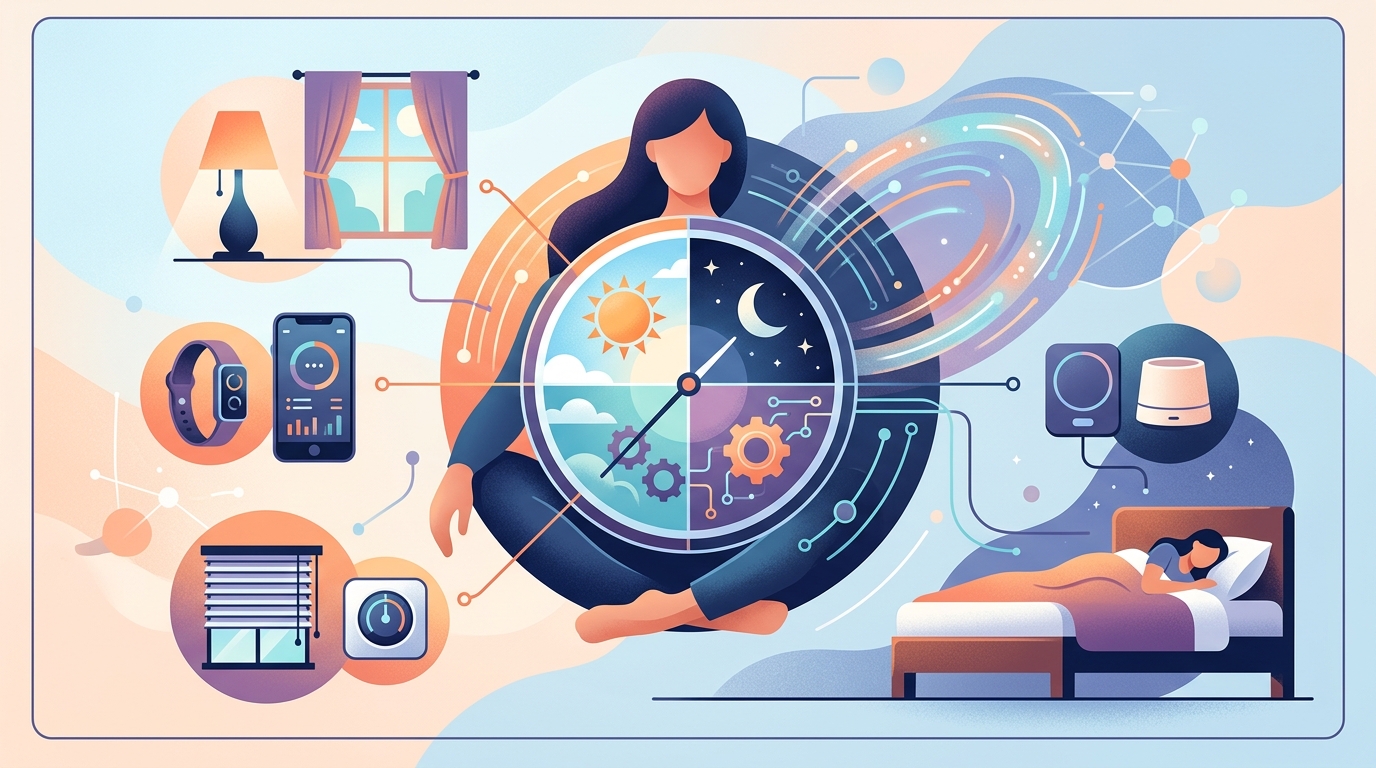
The most important principle is to solve the right problem in the right order. Establish a feasible schedule, consider the timing and context of light, address recurring environmental disturbances, and introduce measurement or automation only when it improves a meaningful decision. When devices disagree, prioritize the broader pattern over an isolated score. When automation becomes burdensome, simplify it. When persistent symptoms remain unexplained, recognize the limits of consumer technology.
A comprehensive system does not need to be technologically elaborate. It needs to support the intended daily rhythm without creating unnecessary interruptions, conflicting instructions, privacy exposure, or false confidence. By combining a small number of complementary tools with careful observation and sensible decision rules, households can build a more coherent environment for circadian support while keeping human needs—not device dashboards—at the center of the process.


Comments
Post a Comment