Are You Blocking Blue Light at the Wrong Time? The Hidden Truth About Circadian Disruption
Are you blocking blue light at the wrong time? The answer may be yes—not because blue light is uniquely harmful at every hour, but because blue light blocking timing is part of a larger biological problem: your circadian system responds to light according to its timing, intensity, duration, spectrum, and your own internal clock.
That changes the usual bedtime story. Putting on filtering glasses at 9:00 p.m. does not automatically cancel a bright, screen-heavy evening that began at 5:00 p.m. And blocking blue wavelengths all day may be counterproductive if it reduces the daytime light signal that helps anchor the biological clock. The useful question is therefore not simply, “Did I block blue light?” It is, “What light did my eyes receive, when did they receive it, and what signal did that exposure give my body clock?”
What is the short answer about blue light blocking timing?
Timing usually matters more than a simple yes-or-no rule. For a person following a conventional daytime schedule, a sensible framework is to seek substantial natural or appropriately bright light during the daytime, then progressively reduce unnecessary bright light as the biological evening approaches. If screens remain necessary late in the evening, reducing their intensity and short-wavelength content can be one layer of that strategy. The goal is not to eliminate blue wavelengths from modern life; it is to give the circadian system a clearer distinction between biological day and biological night.
This distinction is supported by basic sleep physiology. The National Heart, Lung, and Blood Institute explains that light and darkness are major environmental cues for the sleep-wake system. It also notes that bright artificial light late in the evening can interfere with the normal rise of melatonin. See the research-source plan for the NHLBI's detailed explanation.
The practical implication is subtle: a blue-light intervention is not a magic “off switch.” If the room remains bright, a large display is close to the eyes, or strong light enters the eyes from another source, filtering only one portion of the spectrum may leave a substantial circadian stimulus intact.
Why does the same light behave differently at different times?
Your circadian system is a timing system, not merely a light detector. The central clock in the brain coordinates daily rhythms, while light entering the eyes provides one of its strongest environmental signals. The effect of that signal depends on where the exposure lands relative to the internal circadian phase.
Controlled human studies have repeatedly demonstrated a phase-response relationship: light at some biological times tends to delay the clock, while light at other times can advance it. A classic human phase-response study found that the circadian pacemaker responds differently according to the timing of retinal light exposure. More recent work continues to refine how intensity, duration, and spectral composition interact with this timing effect.
This is why “two hours before bed” is useful as a household rule but not a universal biological boundary. Bedtime is a clock-time event. Circadian phase is a biological event. They often overlap in people with regular schedules, but they are not identical.
For someone whose sleep schedule is substantially delayed, for example, 10:00 p.m. may not represent the same biological phase as 10:00 p.m. for someone who routinely wakes at 5:00 a.m. A fixed filter schedule can therefore be too simplistic.
Is blue wavelength the whole story?
No. The phrase “blue light” is convenient, but it can hide the more important concept: the circadian system responds to a light stimulus as a combination of properties.
Short-wavelength light is especially effective for circadian photoreception, and research places important sensitivity in roughly the blue portion of the visible spectrum. But wavelength is only one part of the light signal. Brightness, duration, angle of exposure, background illumination, and biological timing also matter.
One systematic review of human light-exposure research found that evening, nighttime, and morning exposure can all influence circadian phase. Another controlled research program has shown that the spectral sensitivity of melatonin suppression and circadian resetting changes with exposure duration. In other words, a narrow focus on whether a lamp or display is “blue” can miss the larger dose-and-timing problem.
This also explains an important misconception: making a screen warmer does not necessarily make prolonged nighttime viewing biologically equivalent to reading printed paper under very dim illumination. If the screen remains bright and engaging, the intervention has changed one component of the stimulus, not necessarily the entire stimulus.
Could you be blocking blue light at the wrong time?
Consider two opposite mistakes.
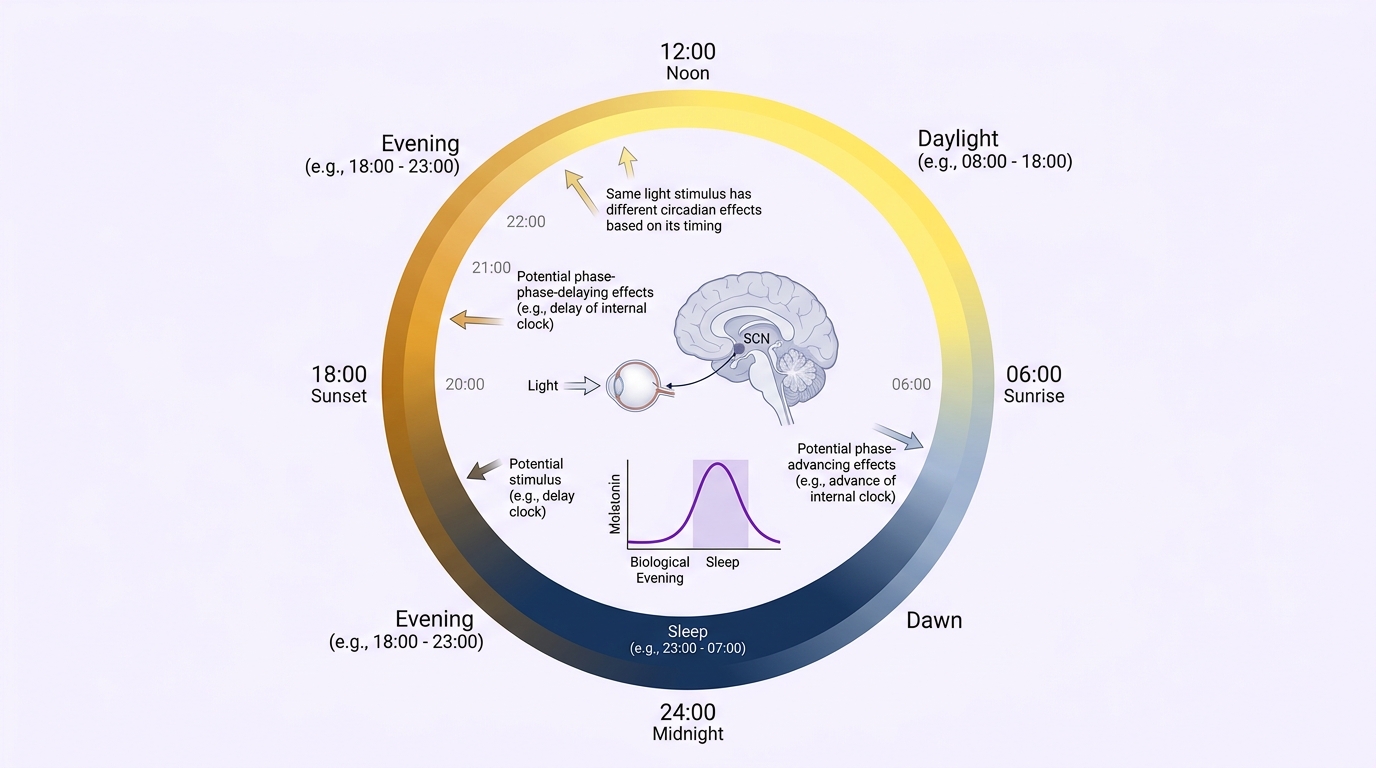
First mistake: blocking too late. Someone may spend several hours in a brightly lit home, use a large television, work on a laptop, and keep overhead LEDs on until 10:30 p.m., then put on blue-light-blocking glasses for the final 30 minutes. That final step may reduce some short-wavelength exposure, but it does not retroactively erase the preceding light history. The intervention is occurring after a substantial portion of the evening signal has already reached the eyes.
Second mistake: blocking too early. Someone may wear strongly filtering lenses from morning through evening because “blue light is bad.” That approach treats a daytime biological signal as though it were nighttime exposure. For a normally timed schedule, daytime light is not an enemy to be suppressed indiscriminately. Daylight helps anchor the distinction between day and night, and clinical guidance uses appropriately timed bright light to shift circadian schedules.
The better conditional logic is straightforward:
- If your main issue is unnecessary bright light late in the evening: reduce overall brightness first, then consider short-wavelength filtering as an additional layer.
- If your daytime environment is consistently dim: do not assume more filtering is the missing solution; strengthening the daytime light-dark contrast may matter more.
- If your sleep schedule is delayed or shifted: avoid assuming that a generic “two hours before bed” rule is sufficient. The timing of light may need to be considered relative to your desired circadian shift.
- If you work nights: conventional daytime advice may not apply. Light exposure may need to be coordinated with the work and sleep schedule rather than simply minimized at every opportunity.
What does the research say about evening screens?
A controlled study published in PNAS provides a useful counterexample to the idea that the problem is merely subjective screen stimulation. Researchers compared participants reading a light-emitting eReader with participants reading a printed book during the hours before bedtime. The eReader condition produced lower evening melatonin, later circadian timing, longer sleep latency, and reduced next-morning alertness.
The study was small and tightly controlled, so it should not be treated as a perfect model of ordinary smartphone use. Nevertheless, it demonstrates why timing matters: the exposure happened in the evening, when the biological system was transitioning toward night.
The finding also corrects another common misconception. If a person says, “I can fall asleep after using my phone, so the light cannot affect my circadian system,” that conclusion does not necessarily follow. Sleep onset, melatonin suppression, circadian phase, alertness, and sleep architecture are related but distinct outcomes.
Conversely, the study does not prove that every screen causes clinically important circadian disruption in every person. Exposure duration, brightness, viewing distance, individual sensitivity, schedule, and the surrounding lighting environment all vary.
Does putting on blue-light-blocking glasses fix the problem?
Not necessarily. Evidence for blue-light-blocking lenses is mixed. A systematic review and meta-analysis of studies using tinted lenses found inconsistent results across trials, although some sleep measures showed possible benefit. The authors emphasized the limited number of studies and the need for additional controlled research.
That is an important distinction from saying that filtering glasses “do nothing.” The evidence can support a narrower statement: filtering short-wavelength light may help in some circumstances, but it should not be treated as a universal substitute for controlling the entire evening light environment.
Imagine two rooms. In Room A, the overhead lighting is dim, the screen is set to low brightness, and the user spends the final hour reading. In Room B, the user wears filtering lenses but sits under several bright ceiling fixtures while watching a large screen. The glasses may alter the spectrum reaching the eyes in both rooms, but the total light environment is not the same.
This is the central editorial correction: blue-light blocking is an intervention, not a biological reset button.
What should an ordinary evening protocol look like?
For someone on a conventional daytime schedule, the most defensible approach is to think in phases rather than one magic cutoff time.
- Anchor the daytime. Get meaningful exposure to outdoor daylight or another appropriately bright daytime environment. This gives the circadian system a strong “day” signal.
- Let the evening transition. As bedtime approaches, reduce unnecessary overhead brightness and favor a calmer, lower-intensity environment.
- Reduce the strongest sources. If a bright display is close to the eyes, lower its brightness and avoid unnecessarily prolonged viewing.
- Use spectrum filtering selectively. If screen use remains necessary, warmer display settings or filtering eyewear can be considered as an additional measure rather than the foundation of the entire routine.
- Protect the sleep environment. Once sleep begins, avoid unnecessary room light. If a nightlight is required for safety, a very low-output warm or amber source may be preferable to a bright white source.
The sequence matters because the goal is not simply “less blue.” It is a stronger day-night contrast.
How should smart circadian lighting fit into the picture?
Circadian technology becomes interesting when it addresses timing automatically rather than merely selling a different color of light. Smart lighting systems can be programmed to provide brighter, cooler or more daylight-like conditions during the daytime and progressively warmer, dimmer conditions later.
The advantage is conceptual: the environment itself can carry the schedule. The National Heart, Lung, and Blood Institute describes light as a powerful cue for resetting sleep-wake rhythms and notes that appropriately timed light can be used to move sleep and wake times earlier or later.
But automation does not remove the need for judgment. A smart lighting schedule designed for a 10:30 p.m. bedtime may be poorly matched to a person who works overnight. A bright “morning” routine delivered at the wrong biological time can also produce a different circadian effect than intended.
In other words, technology can improve consistency without guaranteeing biological correctness. The schedule still has to match the human schedule.
What does the timing problem look like in a simple table?
What is the practical action checklist?
- Identify your usual wake time and bedtime before choosing a light-blocking schedule.
- Look at the entire evening environment, not only the phone screen.
- Reduce unnecessary bright overhead lighting as bedtime approaches.
- Use outdoor daylight during the daytime when practical.
- Dim screens rather than assuming a blue filter alone solves the problem.
- Consider filtering lenses as an optional layer when evening device use cannot be avoided.
- Keep the bedroom as dark as practical during sleep.
- Use minimal warm-colored safety lighting when complete darkness would create a fall or navigation risk.
- If your sleep schedule is substantially delayed, advanced, or shift-based, consider the timing of light relative to your desired schedule rather than using a universal clock-time rule.
- Judge the routine over repeated days instead of interpreting one unusually good or bad night as proof.
What are the important exceptions and trade-offs?
The biggest exception is shift work. A person working overnight has a different behavioral target from someone preparing for conventional nighttime sleep. In that context, “avoid evening light” can be the wrong instruction because the worker's biological evening and social evening may no longer align.
Another exception is safety. A completely dark bedroom is not necessarily appropriate if someone must get up frequently at night and is at risk of falling. A low-level warm-colored nightlight may be a reasonable compromise. The objective is not ideological darkness; it is reducing unnecessary circadian stimulation while preserving necessary function.
There is also a technology trade-off. Automated circadian lighting can make a routine more consistent, but a poorly programmed system can consistently deliver the wrong signal. A simple dimmer used at the right time may therefore be more useful than an elaborate system that does not match the occupant's actual schedule.
Frequently asked questions about blue light blocking timing
1. Is blue light only a problem before bed?
No. Its biological effect depends on timing. Daytime light can be an important circadian cue, while light during the biological evening or night can suppress melatonin and shift circadian timing. The same wavelength therefore cannot be labeled universally “good” or “bad” without considering when exposure occurs.
2. Is two hours before bed the perfect time to block blue light?
There is no universal two-hour biological cutoff. It is a practical household approximation, not a precise boundary of human circadian physiology. The relevant timing depends on sleep schedule, circadian phase, intensity, duration, and spectrum.
3. Should I wear blue-light-blocking glasses all day?
Not simply because blue light exists. For a normally timed daytime schedule, suppressing daytime light indiscriminately may work against the goal of maintaining a strong day-night contrast. The more relevant question is whether unnecessary bright or short-wavelength-rich exposure is occurring at a biologically sensitive time.
4. Are warm screen settings enough?
They may reduce short-wavelength content, but they do not necessarily make a bright screen equivalent to darkness or to a printed page. Brightness, duration, distance, room lighting, and timing remain relevant.
5. Can red light be used at night?
A dim red or amber light is often used when some nighttime visibility is needed because it can provide illumination without recreating the appearance of bright daytime lighting. However, “red” does not mean “no biological effect,” and intensity still matters.
6. Does blue-light blocking improve deep sleep repair?
That claim is stronger than the evidence supports. Circadian alignment can influence sleep timing and sleep-related physiology, but research on blue-light-blocking interventions does not establish a simple guarantee that wearing filtering glasses produces deeper restorative sleep or enhanced tissue repair. It is more accurate to discuss sleep timing, melatonin, sleep onset, and circadian phase as distinct outcomes.
7. What if I can fall asleep immediately after using my phone?
Easy sleep onset does not prove that the exposure had no circadian effect. Conversely, a person who struggles to sleep after screen use cannot automatically assume blue light is the sole cause. Circadian timing, mental stimulation, content, brightness, sleep pressure, and individual differences can overlap.
8. Is daytime light really part of a blue-light strategy?
Yes. The most complete interpretation is a contrast strategy: meaningful light during the biological day and less unnecessary light during the biological night. Treating nighttime filtering as the entire intervention misses half of that signal.
What does the evidence actually allow us to conclude?
The strongest conclusion is not that everyone needs blue-light-blocking glasses. It is that light is a timed biological signal, and attempts to manage that signal work better when they consider timing, intensity, duration, spectrum, and schedule together.
Controlled studies show that evening light can suppress melatonin and shift circadian timing. The research also shows why the details matter: circadian responses vary according to when the exposure occurs, how much light reaches the eyes, how long the exposure lasts, and what wavelengths are present. Clinical guidance likewise treats light timing as an active component of circadian management rather than simply recommending permanent avoidance.
That makes the “wrong time” question more revealing than the usual “blue light: yes or no?” debate. If you block the wrong component at the wrong time, you can end up with a technically sophisticated routine that does little to improve the underlying day-night signal. If you instead build the routine around a strong daytime cue and a progressively quieter evening light environment, filtering can become a supporting tool rather than the entire strategy.
The hidden truth is therefore less dramatic and more useful: circadian biology responds to timing, not marketing categories. A blue-light filter can change the spectrum reaching the eyes. It cannot determine whether the exposure occurred at the right biological moment, cannot erase previous bright-light exposure, and cannot replace a coherent light-dark schedule.
For ordinary schedules, the most defensible principle is simple: make daytime visibly different from nighttime. Then use technology—dimming, scheduling, warmer lighting, screen controls, or filtering—where it helps preserve that distinction. When the schedule itself is unusual, the timing question becomes even more important, because the correct light signal may no longer follow the clock on the wall.
Research basis: This editorial synthesizes government guidance from the National Institutes of Health and peer-reviewed research on human circadian phase response, evening light exposure, electronic-device use, and short-wavelength filtering. The evidence does not support treating any single consumer intervention as a universal solution.


Comments
Post a Comment